
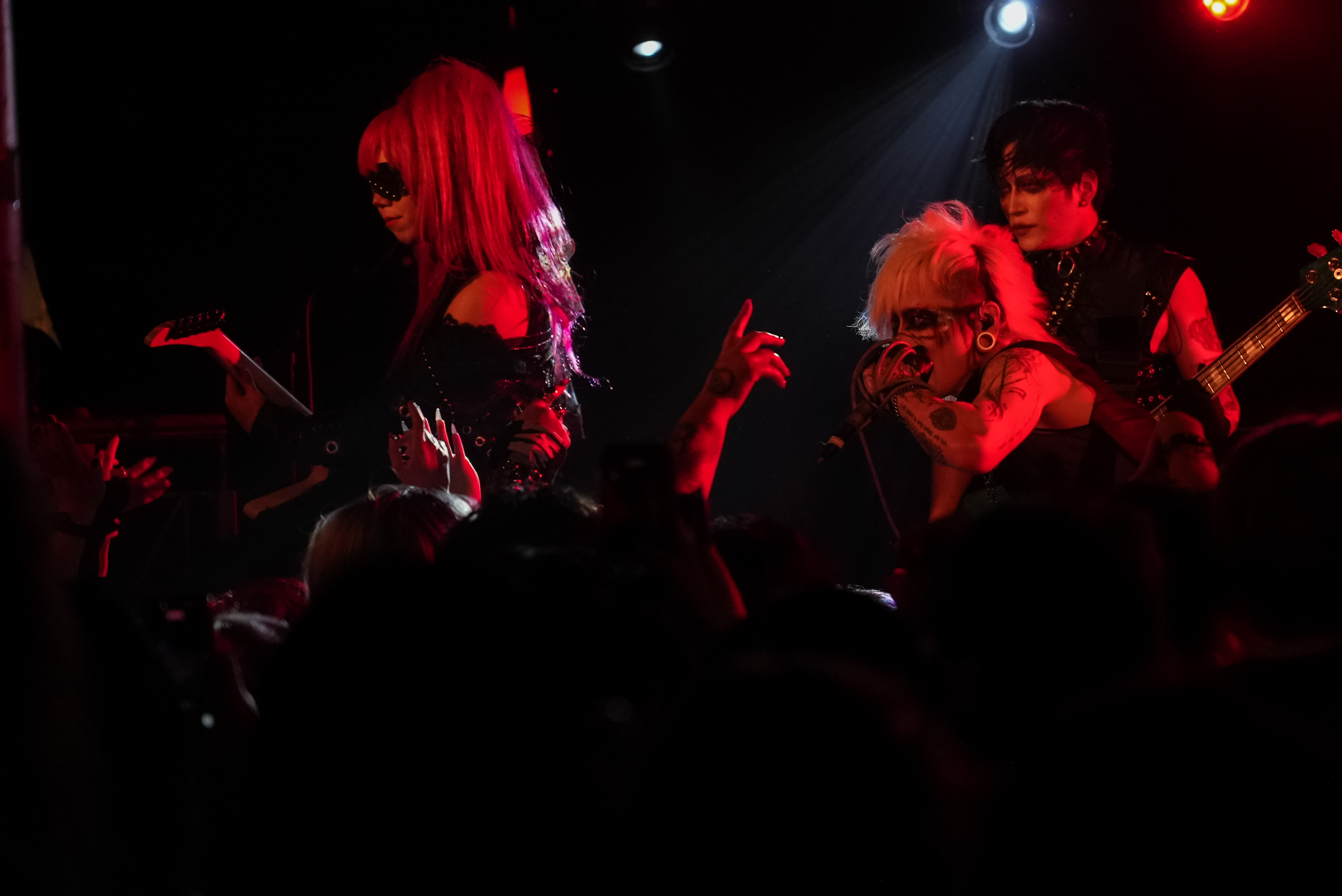
Just over a year after their official launch, Japanese visual kei band BLAZE embarked on their first European tour, RENGOKU. On October 27, 2026, at London’s Underworld, the musicians delivered an intense performance driven by Mio’s powerful vocals and their close connection with the audience. It was a night when the emotions contained in their recordings took on an entirely new dimension.
BLAZE’s story began in February 2025 under the name Mio to Kyuunansha Tachi (澪と救難者達), a session project formed around vocalist Mio. Following several performances in Japan, the musicians announced their new project in May of the same year. On May 31, they released MAYDAY, their first digitally distributed track. BLAZE officially launched on August 11, 2025, with a concert at Ikebukuro BlackHole in Tokyo.
Although the band itself is relatively new, its members are already familiar with Japan’s visual kei scene. Mio previously performed with NAZARE, NERO with KAKUMAY, Kururu with Hueye, and Hotaru-chan with gulu gulu. Now consisting of these four musicians, BLAZE brings together their different experiences to build a shared artistic project.
From the beginning, the band placed a Japanese phrase at the heart of its identity: 「救い難い者達へ」, which can be interpreted as « To Those Deemed Beyond Saving. » According to the official introduction shared when the band was announced, BLAZE seeks to reach out to these people through music, while leaving one question open: does that outstretched hand truly offer salvation?

This ambiguity runs through a discography that has developed rapidly. In August 2025, the band released 失楽園 (Shitsurakuen, « Lost Paradise »), a collection of songs available exclusively at concerts. On February 18, 2026, BLAZE released their first nationally distributed album, DETERMINATIONS., through GOSH RECORDS. Its thirteen tracks combine new compositions with re-recorded material, including GOSH, ANEMONE and MAYDAY.
The band continued exploring its musical identity with ABYSS, a single released on May 9, 2026, whose dark atmosphere extends the emotional themes already present in their earlier work.
A few months later, BLAZE reached another milestone with their first European tour, RENGOKU. Meaning « Purgatory » in Japanese, the title fits the band’s imagery, shaped by ideas of suffering, salvation and determination. For these performances, the four members were joined by Kakeru, formerly of LYRICA, who served as support bassist throughout the tour.
Loud kei et menhera kei : An Aesthetic Between Strength and Vulnerability
To understand BLAZE, it is important to look at visual kei, a Japanese musical and visual movement in which appearance plays an essential role. Elaborate costumes, carefully crafted makeup and distinctive stage personas contribute to each band’s individual aesthetic.
However, visual kei is not a single musical genre. It encompasses bands with widely different influences, ranging from melodic rock to extreme metal, and visual approaches that stretch from romanticism to provocation.
BLAZE is particularly associated with loud kei and menhera kei, two loosely defined labels whose boundaries often overlap.
Loud kei emphasizes musical intensity. Influenced by modern metal, it is characterized by distorted guitars, heavy rhythms and extreme vocal techniques, sometimes combined with more melodic passages.
Menhera kei, meanwhile, refers more to an aesthetic and thematic sensibility. It draws on representations of psychological distress, loneliness and difficult emotions. Rather than describing a precisely defined musical style, it reflects a way of incorporating these concerns into artistic expression.
BLAZE brings these two tendencies together. Their dark, elaborate stage outfits create a provocative appearance, while their compositions combine sonic aggression with more melancholic passages. Their visual identity does more than accompany the music: it helps communicate the character of the songs themselves.


This duality also appears in the band’s lyrical themes. Behind compositions that can sound violent, the lyrics explore deeply human emotions: suffering, regret, loneliness, but also anger and the determination to keep moving forward despite hardship.
MAYDAY, one of the band’s earliest releases, offers an introduction to this approach to songwriting. Its title evokes a distress signal, while its lyrics address past wounds, uncertainty about the future and a refusal to surrender. It gives a voice to feelings that can sometimes be difficult to express.
This tension between despair and determination runs throughout BLAZE’s music. The intensity of their sound can therefore be understood as a means of releasing complex emotions, rather than simply an attempt to provoke.
In Camden, Mio’s Voice Reveals Another Side of BLAZE
On October 27, 2026, BLAZE took to the stage at the Underworld, a venue located beneath The World’s End pub in the heart of Camden Town.
The London neighbourhood has long been associated with alternative cultures and the punk, rock and metal scenes. With a capacity of 500 people, the Underworld forms part of this musical history. Its intimate layout creates an immediate connection between performers and audience, making it a fitting setting for BLAZE’s direct approach to live performance.
As soon as the musicians took the stage, one difference became apparent: the contrast between their recorded material and its live interpretation.

As soon as the musicians took the stage, one difference became apparent: the contrast between their recorded material and its live interpretation.
On streaming platforms, BLAZE’s compositions already possess considerable power. Yet their live performances reveal qualities that are less apparent in the studio versions. The musicians’ commitment, the physical presence of the instruments and the intensity of their playing give the music greater depth.
Mio’s voice offers the clearest example of this transformation.
In the studio, recording allows for multiple takes, adjustments to the balance between instruments and careful refinement of the final sound. This control contributes to the quality of the songs, but it can also soften some of the rougher edges of a performance.
On stage, Mio pushes his voice with an intensity that makes the physical effort more audible. His vocal texture becomes rawer, the tension more noticeable, and the variations in his delivery bring additional expressiveness to the compositions.
These irregularities, which might quickly be labelled as « flaws », are precisely what contribute to the beauty of live music.
They are not necessarily singing mistakes. They are also breaths, textures and moments when the voice seems less controlled, yet more alive. In London, this spontaneity made the emotions conveyed by Mio feel more immediate.
Among the songs performed, ANEMONE stood out as one of the evening’s most memorable musical moments. Featured on DETERMINATIONS., the track illustrates this impression: BLAZE’s compositions take on a different intensity when performed in front of an audience.
The concert therefore does more than make the music louder or more spectacular. It allows listeners to experience its nuances differently, particularly through a vocal performance whose rough edges become an expressive strength.
A Connection That Turns the Concert Into a Collective Experience
BLAZE’s energy was also reflected in the response of the London audience.
At the Underworld, the crowd reacted enthusiastically to the musicians’ performance. Exchanges between the stage and the audience became an essential part of the show, reinforced by the venue’s intimate layout.
The band embraced several familiar elements of rock and metal concerts, including spraying water and interacting physically with fans. The musicians’ attitude gave the performance a spontaneous, at times almost chaotic, atmosphere.


One of the evening’s most surprising moments came when Mio jumped directly into the crowd, crossing the boundary between performers and spectators.
The gesture captured the closeness that defined the night. The audience was not simply watching: it responded to the energy coming from the stage and actively contributed to the atmosphere.
Kakeru, performing on bass for the tour, also took part in the show alongside the four permanent members. His role as a support musician formed part of the band’s live setup for their European dates.
BLAZE’s physical commitment reflects their provocative aesthetic, although it should not be seen as representative of visual kei as a whole. Other bands favour more theatrical or restrained performances. Here, expression relies primarily on the intensity of the music and direct contact with the crowd.
The London show demonstrated how music built around deeply personal emotions can become a shared experience. In this Camden venue, the relationship between the musicians and their fans gave an additional dimension to the band’s artistic approach.
Behind this energy lies a question that has accompanied BLAZE since their beginnings: who is this music really for?
« To Those Deemed Beyond Saving »: Rebellion as a Form of Expression
「救い難い者達へ」. « To Those Deemed Beyond Saving. »
Behind this phrase, which forms part of BLAZE’s artistic identity, lies a question: what does it mean to be considered beyond saving in a society where being different can still lead to misunderstanding?
For some people, failing to meet social expectations means growing up with the feeling of never being heard, understood or accepted. Loneliness, negative thoughts and a sometimes difficult relationship with one’s own identity can give rise to anger that is hard to express.
Seen from this perspective, BLAZE’s artistic universe takes on a particular significance. The heavy, aggressive sounds associated with loud kei can be heard as a musical expression of that anger, while the sensibilities associated with menhera kei allow for an exploration of more internal vulnerability.
Rather than opposing one another, these two forms of expression can complement each other. Behind apparent violence, there may sometimes be suffering that is simply seeking to be heard.
This interpretation also resonates with the place of visual kei within alternative cultures. Beyond its clothing and musical codes, the scene can provide a space for identification and belonging for those who do not see themselves reflected in dominant social norms. Appearance, far from being a mere accessory, becomes a way of asserting individuality.
Alternative music can also offer a means of addressing difficult subjects and expressing emotions that listeners themselves may struggle to put into words. The themes present in BLAZE’s songs, particularly MAYDAY, invite reflection on the relationship between individual expression and the need to be understood.
The phrase 「救い難い者達へ」 can therefore be read differently: not as a condemnation, but as a message to those whom others have already judged, excluded or abandoned.
What if being « beyond saving » sometimes simply meant refusing to give up who you are?
Sources :
BLAZE profile | BLAZEプロフィール | vkgy (ブイケージ) https://share.google/ccrRIObTfesEWiLeB
SITE WEB OFFICIEL DE BLAZE https://share.google/kUQIUwG4ljbLh2IaZ
BLAZE forms from former NAZARE members, debuts music video "MAYDAY" https://share.google/gkl5oLMHkTDw9XIns
What is menhera kei? | vkgy (ブイケージ) https://share.google/d9xcWckwivqFGfsaK
DÉTERMINATIONS. par BLAZE | TuneCore Japon https://share.google/zTDG2a8Xg2sIOOCKS

Merci à Killian Daze Management. All photographs are under ©Sophie Savinois. French version here.
Réponse
[…] Sources : BLAZE profile | BLAZEプロフィール | vkgy (ブイケージ) https://share.google/ccrRIObTfesEWiLeBSITE WEB OFFICIEL DE BLAZE https://share.google/kUQIUwG4ljbLh2IaZBLAZE forms from former NAZARE members, debuts music video "MAYDAY" https://share.google/gkl5oLMHkTDw9XInsWhat is menhera kei? | vkgy (ブイケージ) https://share.google/d9xcWckwivqFGfsaKDÉTERMINATIONS. par BLAZE | TuneCore Japon https://share.google/zTDG2a8Xg2sIOOCKSMerci à Killian Daze Management. Toutes les photos sont ©Sophie Savinois. Version anglais ici. […]